Interview with Ieuan Compton - B2B Vs B2C Marketing
4 April 2023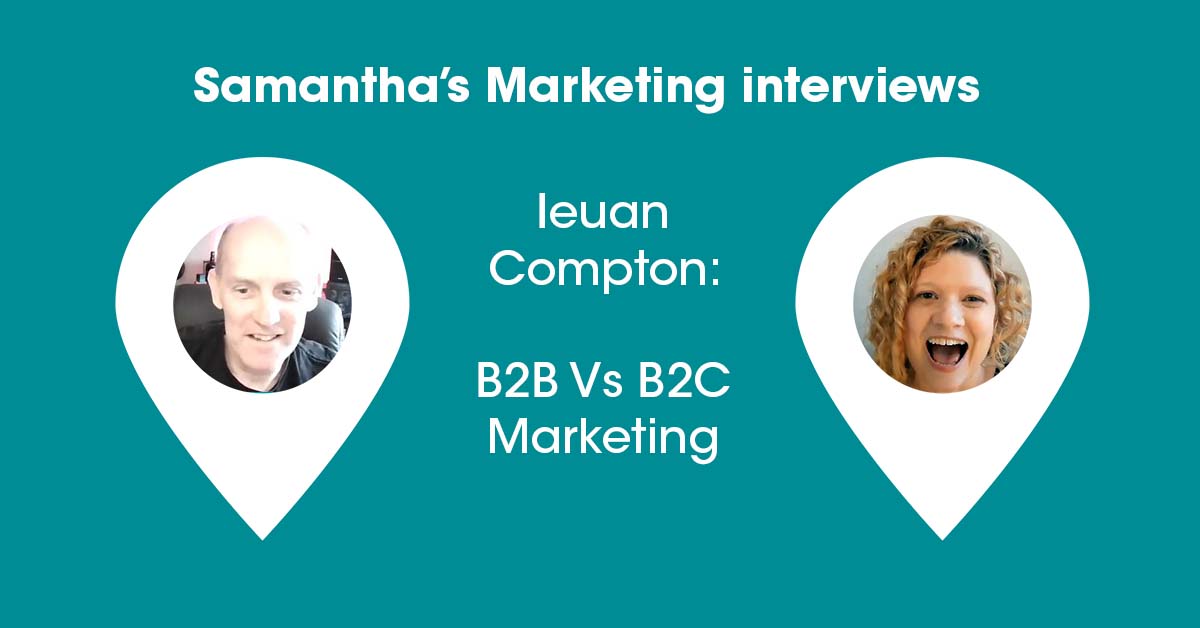
In Samantha’s latest video she spoke to experienced B2B marketer Ieuan Compton about the differences and similarities in Business to Business and Business to Consumer marketing. Is there any difference between B2B and B2C marketing? You might think that they are completely different! But this interview reveals more similarities than you might expect. In this discussion Ieuan explains the “people buy people” concept and how to apply it to various areas of marketing.
Links:
Watch the video, or read the transcript below if you prefer.
Transcript:
Samantha Tonge: Hello again, everyone. This is another one of my expert interviews. Samantha Tonge here, Labrakita Marketing. And today I'm speaking to someone who used to be my boss. He is Ieuan, and we're going to be talking about B2B marketing, how it differs from B2C marketing, and the things that you need to think about. So Ieuan, can you introduce yourself, please?
Ieuan Compton: Yeah. Good morning, Samantha. So yeah, I'm Ieuan Compton, I've been doing B2B marketing in construction products in particular, for nearly 30 years. Been around the block a few times, worked for a few multinational companies. Still excited by it, still gets really... it's all in amongst the weeds, but yeah still get a bit of buzz from it. Still love it. And you're quite right. I did used to manage Samantha. Geeze, that was best part of 15 years ago.
Samantha: Must be. Yeah.
Ieuan: And it was a pleasure.
Samantha: Oh thank you! So today, we're talking about B2B marketing. So if you don't know, B2B stands for "business to business". And, yeah, so Ieuan, what do you think the key differences/similarities are there between B2B marketing and B2C, which is "business to consumer"?
Ieuan: Yeah, so. I had a think about this question prior to the interview, or prior to this recorded meeting. And I'm not sure there is a huge difference. I think there is definitely a difference in our approaches, but I think in terms of, we, as individuals, whether we're buying for personal use, as a consumer, or whether we're buying for business use, as a business user, we still buy people. We still look to get something that we deem is value for money, and will do what we expect it to do. So in that respect, I think there are quite a lot of similarities. I think that people buy people, first and foremost. And I can be switched off a purchase by an individual more than anything else. I have been known to walk out of shops, and buy the same product at another shop that's more expensive, because I've preferred the salesperson or the approach of the salesperson. And I think, post-COVID and post-lockdown and post-"everyone's-working-from-home", I think we've also seen a shift. I think that one-to-one relationship, or that feeling of a one-to-one relationship is probably far more important now than has ever been, because we crave a little bit of human interaction.
Samantha: Yes, yes. Especially after the last two years of being stuck in the house, and not speaking to people face to face. It's been a bit more... I think it's changed all sorts of things. I think a lot of people probably haven't re-looked at their brand, which they should do now, because things have changed.
Ieuan: I think, fundamentally, they have changed. Our attitude towards brand has also changed. I think with certain products we are probably less brand-loyal than perhaps we were before. And that's because we've spent a lot of time purchasing stuff over the internet. And we go online and do a search for, I don't know, a Makita drill, for example. And we get: "Alright, here's a Makita drill, but here's different models, here's a different brand. But you might also be interested in these, and people who looked at this also went on to buy that." And I think our brand loyalty will have diminished a little bit, because we're given so much choice.
Samantha: Yeah, that's also an excellent point. And you mentioned that people still buy people. People still want something that works for them. But one thing I have come across, when I'm talking to B2B clients, is that they think that it’s all about the facts. Especially in my industry, where there are a lot of really technical people. Give them the facts, the big data sheets that gives them everything and then they'll know exactly how wonderful my product is. And sometimes it takes some convincing them that: "No. Okay. First of all, you want to catch their attention before they're even going to look at your datasheet. That's further down the line. Secondly, emotion is actually important in business to business."
Ieuan: Yeah. It absolutely is. And I think technical industries in particular tend to be quite guilty of going: "Here's our product. This is what it's made of. This is what it does. This is how it does it. This is what you need to watch out for. Here's health and safety assessment, GSD, the LCA document. Here's all the technical information that we've got, because we love and invest in our product, and we think it's wonderful." Whereas you, as the purchaser, are going: "Yeah, but how does it help me?" "Just give me that nugget, just tell me that if I use this product, I haven't got to do X, Y, or Zed. Or if I do do X, Y, and Zed, I get a much better performance, because of A, B, and C." And we all, as marketers, at some point in our career will have fallen into that trap of talking about the product and why it's wonderful and not actually telling the customer about why it's good to have the product and what benefits it brings to them.
Samantha: Yeah, what does it actually mean to them? Why you? And it isn't necessarily: "This widget does X, Y and Zed," it's how that helps the customer. Say, it could be like... at the moment I guess a lot of people are looking for things that will save them energy, because it will save them money, as that's a big issue.
Ieuan: I've actually got a very good example. It's a B2C example, but for my 50th birthday, my wife said: "I'm gonna buy you a new turntable. You love your music. Let's go and buy a decent turntable." And we went to this music hi-fi shop in Nottingham. And the guy said: "Right. When you come in, bring some of your records with you. And what we'll do is, we'll sit you in a room and we'll play different turntables with your amplifier, with different speakers. And we'll work out what makes your music sound the best. And it may not be the most expensive turntable, it might be a cheaper one," and all this sort of stuff. And we spent an hour, hour and a half, in this man's shop with him just swapping in and out turntables, listening to my music and going: "Well, that one sounds better than that one. That one sounds better than that one". And in the end, I didn't buy a particularly expensive turntable from them, it was a good quality, mid-range one, but I did go back and buy a set of speakers from him. And I have gone back since and bought other components from him, because he spent the time and wasn't forceful or pushy. That said, this is kind of... You know, a turntable is a turntable, you put the arm on the record and it plays music. Well, actually, that's the B2B trap. It's a turntable. It plays records. It's wonderful. The actual softer bit, the "What did it do for me?" was that it made some records that I love, sound even better than they did before. And he sold to me the most pleasurable sales experience I've ever had.
Samantha: That's amazing. And in retail, experience is going to become more and more important
Ieuan: Indeed. Yeah. Well, it might become true of B2B as well, because we’re currently having physically less contact.
Samantha: Probably. Yeah.
Ieuan: It may be that visitor centres, experience centres, brick-and-mortar showrooms for production products will become more popular. Again, I'm going to put a caveat on this, because this also depends on the audience. Certain audience types don’t miss in-person contact, they are not extroverts. And you'll find this with a technical sell as well, that many don't crave the human contact, therefore, they might be less likely to go to a visitor centre. But I think overall we will see an upsurge in that type of physical infrastructure to support sales activities.
Samantha: Yeah. Talking about this being dependent on the audience brings me onto my next question. How should we go about segmentation and positioning in B2B?
Ieuan: Yeah. Again, this is something that if you read the textbooks, a lot of people talk about it, but actually you don't see it all that often. Which is why I think a lot of marketing activity kind of gets, not lost and confused, but it gets devalued in the business, because this process hasn't been followed. I would nearly always advocate for mapping out the entire purchase process.
Let’s take the sale of a building product as an example. I'm going for this because it's my experience. So if you look at a building product, it's specified by an architect. It's then value-engineered by a main contractor, it’s then fitted by a subcontractor. And it's then used by the client at the building, and finally maintained by the facilities management team. So you've got lots of different stakeholders on that journey.
And each of them might have a slightly different message as to why your product is wonderful. The architect will like it because it's aesthetically pleasing, and it allows his creative juices to go absolutely crazy. But then there’s the services guy, at the other end of the chain, who wants to know that once it's installed, he hasn't got to touch it for thirty years. Or if he’s got to touch it, there's no health and safety implications, no dispose-of implications, or it's easy to do. Then there's the contractor, who is interested in price and installation time, while the subcontractor wants to know that if he installs it, and there's a problem, he's not gonna get a call back. And there's all these different messages for the same product by different audience types.
And then even if you think about one of these stakeholder groups the message isn’t homogeneous. Let's just pick on the architect for a second, because it's fun to pick on architects. There are different types of architects. You've got creative architects who design wild and wacky buildings, and pass it off to an engineer to make work. And then you've got real practical architects who want to get involved in the technical detailing. So you see, you've got different messages even within the architect audience.
Samantha: Yeah. And I think that's very common in B2B, that's not just construction. I think that's pretty much everywhere, that there are multiple people involved and not just in the decision-making stage. Although even at the decision-making stage, you've got the person who signs it off, who might not even be the person that you're talking to. Then you've got the person that you're talking to, and there are all sorts of other influences as well. And like you say, they've all got slightly different needs. And, I mean, a lot of marketers also forget, like you say, the customer journey. As it happens, I've recently mapped out mine again, because it's changed slightly. And yeah, there are different stakeholders. So for me, for example, which is quite different, but for me, there'll be marketing directors, there'll be finance people who are about cutting costs, and asking "why marketing?". You know, they might say it's a cost and not investment, so I've got to educate them. There are Managing Directors and CEOs who have their point of view. And within engineering, there'll be, you know, the engineering manager, but then there'll be the purchasing department, whose targets are all about cutting costs, and so, you know, even just at that stage, you've got all these different people. And like you say, there are all these other influences further down the line. And you might be thinking: "Oh, yeah, but they're not part of the decision-making process". But that feeds back up.
Ieuan: Exactly. To just on your point there, about these different influences you've got in your business. Yeah, you've got the finance person, you've got the marketing person, you might also have the MD. They all speak a slightly different language.
The accountant will be talking about Return On Investment (ROI) and KPIs and all these different business acronyms that we seem to love and cherish. And that language will be quite different to the MD’s. The MD wants to know: “How are you going to affect my bottom line?”, the marketing director wants to know how you're gonna make his life easier, and make him look good, or make them look good. So the language is different as well. And that kinda then leads to the next step. Once you've got this customer journey and you've identified the different segments you want to talk to, you've then got to build a persona or a personality map, or something that says: "Okay, I'm going to target this type of architect, this is their education background, this is the language and the phrases they like, these are the things that motivate them."
In the case of a creative architect it will be: "We're going to give you something that makes it really easy for you to be individual and create something that is going to be there for a lifetime, as a legacy piece.” And so, they've all got different drivers.
And actually capturing that at the very start of the process allows you to tailor your messages, and your marketing campaigns directly to them, with a bit more impact, and with a higher chance of success. And sometimes we get it wrong. And the personas might be slightly wrong, we've got the messaging current wrong, but that's where you test and trial and go back and you adapt it. But if you always go back to that source point, then life becomes a bit easier.
Samantha: Definitely. And it's not just about, as a lot of people think: "Oh yeah, it’s just getting the ads right, getting the social media right." It's at every single touch point. Because if it falls down when they speak to your finance department and that conversation puts them off. Or they... Everyone needs to understand what the message needs to be, or what the messages are. And everyone needs to understand what their place in it is.
Ieuan: Yeah. Absolutely. It can work both ways as well. You know, I've started with this user journey, talking about architects, from one end until the other. Actually, the clients can sometimes be the influencers. So if you think of new build housing, for example, when we, as consumers walk into a show home, we typically look at the kitchen and the bathroom and that type of stuff.
And then we have requests for the house builder, where we might go: "Oh, we want one of those fancy cooker taps." And it may be something that they've not thought about. But that then goes back up the chain and at some point, it will hit the right department and they'll go: "Well, we've had a number of people asking for this fancy cooker tap." And they'll then start to incorporate it. So it can go both ways. And in particular with construction, the subcontractor may not like using your product, because there's something unique about it, and they may have a preference for a competitor's product. And they might then go: "Okay, I know you've specified this product, but we can give you this one. It's roughly the same." And so the chain can work both ways.
Samantha: Yeah. Yeah. Yeah, absolutely. And even if it's the same people, even if you're dealing with the same influences sort of at the end, as well as the beginning, you need to give them that confidence that they've made the right choice.
Ieuan: Absolutely. I'm trying to think of an example. I suppose IBM, you know, years ago had that struggle and yet no one ever got sacked for buying IBM.
They probably did in the end because it cost them a small fortune, but at the time, they were probably right. And there was a comfort that came with buying that big brand in a time where there was some uncertainty and some lack of knowledge, or lack of expertise around those types of bits of kit. And sometimes that's the marketing message. Sometimes the message is just: "Hey, look, we've been doing this for 50 years. You can trust us. Look at all these wonderful buildings", in the case of construction that have used this product. Which definitely illustrates the value of a case study.
Samantha: Yes, plus case studies are a form of storytelling. Like in B2C, there's lots of storytelling, and there are lots of ways to do that. But in B2B, I think the fact that case studies are a story, as well as a tool for confidence building in your product is what makes it powerful. It's something that you're telling in story form, which is more engaging. I think that's one of the reasons it's one of the best performing pieces of content in B2B marketing.
Ieuan: Yeah, absolutely. And if done properly, by non-technical people, or technical people who have woken up to the fact that they've got subtle benefits, it starts with a problem statement. "On this building, we wanted something that was non-combustible because of this. And the client came to us and we gave them this solution, because our product does that, etc.” You know, there is a story to be told. And the story always starts with the problem statement. The specifier wanted something because they had to overcome a problem. And that problem could be as minor as they wanted something green in the kitchen, or it could be something as major as they want you to stop the building burning down.
Samantha: Yes. Yes. That’s very true. And I think, to a certain extent, this is one of the bits where there's a difference between B2B and B2C. With the exception of certain things, because think automotives: the main one where people do more research after they've made the purchase than before they've made the purchase. But within B2B, especially if you're talking about something that could make a building fall down, or a big piece of engineering that they need to keep the production going or, you know, you're talking about people whose job could be on the line, or their career advancement, when that promotion may or may not come based on the purchase they make. So there's quite a lot at stake in a lot of business-to-business sales.
Ieuan: It's also somebody else's money. And therefore, you're always going to have a bit more scrutiny than if you're spending your own money. And your automotor example is quite a good one. If I were to go out and buy a car, I would buy one based on the comfort, on the sound system or whatever. Whereas if I was being given a company car, there'd be a different set of criteria, a different set of value propositions being attached to that vehicle. So I think that's a very good example of how different the user journey is for consumer compared to a business user. A business user will be looking at the resale value, the leasing cost, the running costs, and all that type of stuff. Whereas consumer is going: "Does it come with that lovely shade of orange that I want?"
Samantha: Yes. Yeah, absolutely. Absolutely. So I think there is a bit of a difference there, in most... Yeah, different criteria. And it's different emotions involved, it's different criteria that people have in B2B compared to B2C. But the basics are the same: the same structure, the same things you've got to think about. But I think in most cases, there's a lot more that needs to be done at the end of the customer journey, you know, after the purchase, than maybe usually needs to be done in B2C. Except for: "it's just the same, bring them back again, get them to buy another Mars bar." You know? Whereas in B2B, you need to get them to think they've made the right decision and then, like you say, get them back to your store. I guess your record shop is a good example. You've gone back to that. You've got that confidence in the shop now, so you will go back for anything related.
And even if it's like a huge purchase, that you tend to sell to one customer once every 20 years, if it's this big, I don't know, a big piece of machinery or something; they talk to other people in their industry.
Ieuan: Absolutely. I have recommended the record shop. I've said to, you know, friends that I bought this turntable. “These guys were superb. This was the experience I got.” And you're quite right, I don't know if any of my friends have gone to the shop to purchase. But that word of mouth has happened. And that happens in industry as well. That happens in B2B. Somebody on a building site might be using the Makita drill, I used as an example at the start of the conversation. And you know, they might say to their mate who needs a new drill, "Well, I've had a Makita for over 10 years, I've replaced the brushes twice since day one," and whatever the message might be. And they then might go and buy a Makita drill, or at least look more favourably at the Makita when they're looking at the options, because Dave, their mate has told them that it's a good drill. As opposed to an advert in a magazine telling them it's a good drill, where they all go: "Yeah, but you would say that, wouldn't you?" But Dave hasn't got that vested interest.
Samantha: Yes. Yes. And the other thing in B2B you've got to think about is the fact that most industries are quite incestuous in terms of the people they employ. So take an engineering manager for example, who moves from one factory to another, and realises: "Oh, they've got the same problems that I had in the previous place. I know who to call, the people that helped me before." They're also, we talked about case studies, if they're happy with you, and you've done all that confidence building after the purchase as well, and done things for them, they're far more likely to go: "Yeah, I'm happy to put my name against a case study."
Ieuan: Yeah, absolutely. There's an interesting twist in that one later on, that many don’t realise. If you've done all the selling, if you've gone to the specifier and you've built that rapport and that relationship, and you've sold them on your solution, if you then move business, which does happen, chances are, you're going to take that client with you, because they trust you. And as long as you've got the right solutions for them, they're gonna stick with you. Because we tend to be loyal to individuals.
So the shop that I bought my turntable from, that's just a shell that sells bits of electronic equipment. It was the guy in the shop that spent the time with me, talked me through, and explained stuff to me. It is him, who I've actually got a relationship with and I'm loyal to. I will go back to him, because I trust him that if I'm going to spend an obscene amount of money on a piece of electronics, he will give me something that I'm going to get value from and not just rip me off and take my money.
Samantha: Yeah. Which, again, sort of brings us back a little bit. I mentioned earlier that it could all fall down, for example, when it gets to the finance department, if it's the wrong message and they put the customer off. We need to make sure that everyone in the business and every new person that joins the business understands what your brand is, what your messaging is, what it is you're saying, especially about you. So that, hopefully, you've got a better chance of retaining customers as well as winning new ones.
Ieuan: But actually, there are tools that help to ensure that. So as part of the user journey, obviously, you've segmented all individuals. And as we've said, all of these individuals have got their own motivations for buying products and choosing products. And actually, what you do is, you build up a message house that says: "Okay, so the lead performance for our product might be, I don't know, fire performance. Okay, so what does that mean to the creative architect? What does that mean to the accountant? What does that mean to the subcontractor? What does that mean...?" You know. And you build up the messages, but they all link back to the one message. So no matter who's getting the message at what stage of their journey, and the language might be different that you use, but they're all getting the information: "This product is good when it comes to fire". The message house is a relatively common marketing tool that allows you to have that consistency. And that message house then would get replicated across all different media types, whether that be a printed advert in a magazine, your website, a video, or a CPD (Continuous Professional Development) presentation being given at a trade show.
Samantha: Yeah, yeah, absolutely. Absolutely. And then, you know, your new sales guys are trained up on this. So take that shop for example. Say that's an employee you were dealing with. I imagine he might be the owner though.
Ieuan: He was.
Samantha: But let's say he is an employee. And next time you go in, it's a different guy with exactly the same approach. And you're still happy to go back to that shop.
Ieuan: Yes. Yeah, it would be any change of behaviour, that would then self-divide that brand. So that consistency is quite important. And that message needs to be the right one. You know, now even more so in construction post-Grenville, there's this added scrutiny on us as an industry. And there's a requirement for us to be honest, open, transparent, and delivering understandable messages to all audience types. There's talk of competency schemes and auditing schemes and all types of stuff that's going to affect the technical way that we write about our products. I'm going to use the word fire as an example again. You know, fireproof doesn't really exist, but it's a phrase that we hear quite often: "Oh yes, it's fireproof". Well, is anything really fireproof? At a high enough temperature, most things burn. So therefore, fireproof doesn't technically exist. But it's a language that marketers will have used for the past 20/30 years.
Samantha: Right.
Ieuan: And actually now what we talk about is fire resistance, or resistance to fire and the language is changing, as the legislative landscape and as we, culturally change.
Samantha: Because people took that literally?
Ieuan: Well, I think there was a general lack of understanding.
Samantha: Oh, okay.
Ieuan: In certain parts, there was a lack of understanding. It was also a case of marketers being overzealous with their language. Again, that comes back to where the message house can come quite handy. This is what you say. You don't say this, because it's not true.
Samantha: And sales guys as well, not just marketers. We need to make sure they don't promise more than we can deliver. Please.
Ieuan: That's the other challenge now. We're all salespeople now. You know, most people are on social media.
Samantha: True. Yeah.
Ieuan: And they will be sometimes commenting, and they will be sharing their company updates and bits and pieces. So we've kind of all become salespeople to a lesser or a bigger degree. And you're quite right, that consistency of message across all of those channels by all of those individuals, that is critically important.
Samantha: Yeah. And I think like you say, even more so now, as more and more people are more comfortable using social media channels. I mean, I thought LinkedIn was pretty busy before lockdown. It has got… I mean, it's so busy now. It's so much harder to get your message across on it, than it ever was before. I thought everyone was on there already. But no. So, and people are much more comfortable discussing things in that sort of more relaxed way. But it seems rather public. I mean, before lockdown it was already researched that, you know, the best performing companies were ones where everyone in the business understood what the brand stood for, and what, you know, they meant to the customers. And it's something I hadn't really thought about until you've mentioned it, that that's probably multiplied.
Ieuan: Oh, for sure. Absolutely. I think we talked early on about the lack of physical interaction with people. So we're doing more stuff on social media, we do more stuff by video, we're doing more stuff by direct message and chats, we're doing more stuff by having conversations around topic posts. Because, as human beings, we, even the introverted ones amongst us, still require a little bit of human interaction in order to function, develop, and learn. I think that social media, particularly, and LinkedIn is a very good example. It was always a stuffy, very formal platform. It's relaxed a bit. And now, as individuals, we're showing that we're human beings.
They're still linked to work, loosely, every now and again. But there is a bit more softer content on there, that says, you know: “I'm an individual, I'm doing this with my company. I'm walking up Scafell Pike three times backwards, in a pair of wellies and a bikini,” or whatever it might be, you know. But people are showing their personalities. Which then sends us back to the very start of this conversation: people buy people.
And what we are seeing on LinkedIn is that people are getting more savvy, and they are targeting a particular segment of their audience. They are being very specialist, being very, very focused and very targeted, and not chasing 20,000 impression views. They're chasing half a dozen real valuable ones that they can build off of.
Samantha: Quality over quantity.
Ieuan: Absolutely. And in a noisy space, like LinkedIn has become more so. I mean, it's not as noisy as Facebook, it never will be. But in a noisy space, if you can carve out that niche and become the specialist, the voice, the expert, then your audience will gravitate towards you. Because we're all relatively curious to a lesser or greater degree, and we go searching for stuff. And if you're talking to that niche, they will find you and follow you.
Samantha: Yeah. Yeah, absolutely. And I think that's a great point to sort of finish up on, really. Because I think that's what it boils down to at the end of the day: finding that niche. It just needs to be big enough that you get enough money from it, but small enough that you can target your messaging more easily. It will make your life a lot easier.
Ieuan: Yeah, there'll be no point targeting somebody that's looking for a burnt orange car, that does a hundred miles to the gallon, that has leather seats, and three exhaust pipes. Because you're just not going to find that niche. But you are going to find someone that's looking for an energy efficient car in a lurid colour.
Samantha: Absolutely. Brilliant. Okay. And just before we go, do you happen to have anything to plug?
Ieuan: Not really. I'm doing this out of the goodness of my heart. If somebody wants to connect with me on LinkedIn, I'm more than happy, they can find me. It's Ieuan Compton. What I don't like is people connecting and then sending me sales messages. But I'm more than happy to connect and have a conversation and interact.
Samantha: Brilliant. I shall put your LinkedIn link on my website when I publish this. Brilliant. Thank you very much. And thank you for watching. Bye, everyone.
Ieuan: Bye.
Interviewer: Samantha Tonge, Managing Director, Labrakita Marketing
If you need help with your Engineering or Tech marketing strategy contact me on 07791 521439 or email me at samantha@labrakita.co.uk. If you would like to have a conversation with Ieuan on LinkedIn you can find his profile here.